
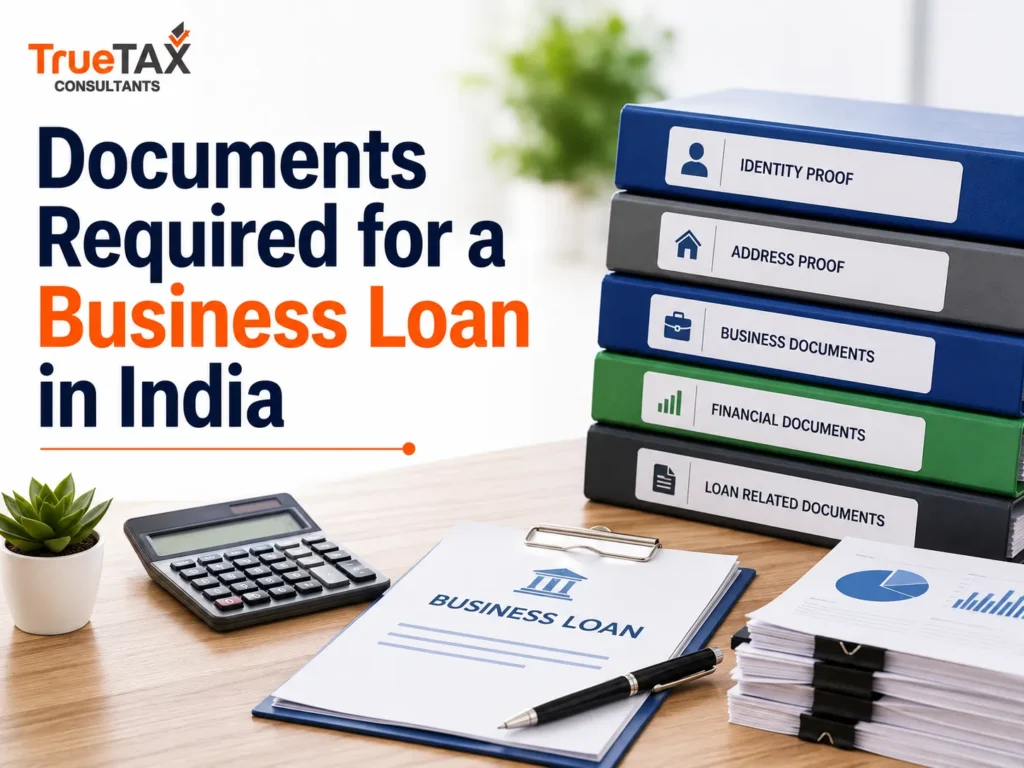
Starting a business, expanding operations, purchasing machinery, managing working capital, or upgrading technology often requires additional financial support. A business loan helps entrepreneurs, startups, MSMEs, and established companies meet these financial needs without disrupting daily operations. However, before approving a loan, banks and non-banking financial companies (NBFCs) carefully evaluate the applicant’s identity, business performance, financial stability, and repayment capacity through a set of mandatory documents.
Understanding the documents required for a business loan in India before applying can save valuable time, reduce processing delays, and improve your chances of quick approval. Whether you are a sole proprietor, partnership firm, LLP, private limited company, or startup, maintaining the right documents demonstrates that your business is legally compliant and financially reliable. In this comprehensive guide, you’ll learn about every document lenders typically require, why these documents are important, and how to prepare a complete loan application for a smoother approval process.
What Are the Documents Required for a Business Loan in India?
The documents required for a business loan in India are a collection of personal, business, financial, and tax-related records that help lenders verify your identity, evaluate your business operations, and assess your ability to repay the borrowed amount. Although the exact documentation may differ depending on the lender and loan type, most financial institutions ask for a standard set of documents during the application process.
Generally, the required documents include:
- Identity proof
- Address proof
- Business registration documents
- Business ownership proof
- GST-related documents
- Income Tax Returns (ITR)
- Bank statements
- Financial statements
- Passport-size photographs
- Loan application form
- Collateral documents (for secured loans)
Keeping these documents updated and readily available not only speeds up verification but also increases the confidence of lenders while assessing your application.
Why Are Documents Required for a Business Loan in India?
Every lender follows a structured verification process before approving a business loan. The documents submitted by the applicant allow banks and NBFCs to determine whether the business is genuine, financially stable, and capable of repaying the loan within the agreed timeline. Proper documentation also helps financial institutions comply with regulatory requirements issued by the Reserve Bank of India (RBI) and Know Your Customer (KYC) guidelines.
Lenders generally use these documents to:
- Verify the applicant’s identity.
- Confirm the legal existence of the business.
- Assess annual turnover and business revenue.
- Evaluate repayment capacity.
- Review tax compliance.
- Check existing loan obligations.
- Prevent fraud and identity theft.
- Comply with RBI and KYC regulations.
Submitting complete and accurate documents required for a business loan in India significantly improves your chances of faster approval and reduces unnecessary back-and-forth communication with the lender.
Complete Documents Required for a Business Loan in India
While documentation requirements vary across banks and NBFCs, most lenders request documents under several common categories. Preparing these documents in advance ensures that your application process remains smooth and hassle-free. Let’s understand each category in detail.
Identity Proof
Identity proof is one of the most important documents required for a business loan in India because lenders must verify the identity of every applicant before processing the application. The submitted document should be valid, government-issued, and contain accurate personal information.
Commonly accepted identity proof documents include:
- PAN Card (Mandatory in most cases)
- Aadhaar Card
- Passport
- Driving Licence
- Voter ID Card
Among these, the PAN Card plays a crucial role because it is linked to your tax records and financial history. Aadhaar is also widely accepted for completing KYC verification.
Address Proof
Address proof helps lenders verify the residential or business address of the applicant. It also enables banks to maintain accurate communication records and comply with regulatory verification requirements. The address provided in your application should match the details mentioned in the supporting documents.
Accepted address proof documents include:
- Aadhaar Card
- Passport
- Driving Licence
- Electricity Bill
- Water Bill
- Telephone Bill
- Property Tax Receipt
- Registered Rent Agreement
- Municipal Tax Receipt
If your business operates from rented premises, the lender may also request a valid rent agreement along with recent utility bills.
Passport-Size Photographs
Although digital loan applications have reduced paperwork, passport-size photographs are still commonly requested by many banks and financial institutions. These photographs are used for KYC verification, customer records, loan agreements, and other official documentation.
Applicants should generally keep:
- Two to four recent passport-size photographs
- Clear background photographs
- Latest photographs matching current appearance
For partnership firms and companies, photographs of partners, directors, or authorized signatories may also be required.
Business Registration Documents
Business registration documents prove that your business is legally established and authorized to operate in India. These are among the most important documents required for a business loan in India, especially for registered businesses seeking larger loan amounts.
Depending on your business structure, lenders may ask for:
- GST Registration Certificate
- Udyam Registration Certificate
- Shop & Establishment Certificate
- Trade Licence
- Certificate of Incorporation
- Partnership Deed
- LLP Registration Certificate
- LLP Agreement
- Memorandum of Association (MOA)
- Articles of Association (AOA)
- Professional Tax Registration (where applicable)
The exact documents required depend on whether you operate as a sole proprietorship, partnership, LLP, private limited company, or another business entity.
Financial Documents Required
Financial documents allow lenders to evaluate your business’s financial health, profitability, and repayment capability. These records provide a complete picture of your business performance and help determine whether your income is sufficient to repay the requested loan amount.
Bank Statements
Business bank statements are one of the primary financial documents examined during loan processing. They provide lenders with insights into your daily transactions, monthly turnover, cash flow, and existing financial commitments. Regular business transactions and healthy account activity often strengthen your loan application.
Most lenders ask for:
- Last 6 to 12 months’ business bank statements
- Statements from primary operating accounts
- Details of existing loan repayments
- Evidence of regular business income
Banks carefully review these statements to understand the consistency of your cash flow and overall financial discipline.
Income Tax Returns (ITR)
Income Tax Returns are another important part of the documents required for a business loan in India. They demonstrate your tax compliance, reported income, and overall financial credibility. Businesses that regularly file their tax returns are generally viewed as more reliable borrowers by lenders.
Most banks request:
- Income Tax Returns for the last 2–3 financial years
- Income Tax Acknowledgements
- Computation of Income
- PAN details linked to tax filings
Timely filing of ITR not only supports your loan application but also reflects responsible financial management.
Financial Statements
Financial statements are among the most critical documents required for a business loan in India because they provide lenders with a detailed overview of your business’s financial performance and stability. These records help banks assess your profitability, assets, liabilities, expenses, and overall financial health before making a lending decision. Businesses with accurate and well-maintained financial statements generally have a higher chance of securing faster loan approval.
Common financial statements required include:
- Balance Sheet
- Profit & Loss (P&L) Statement
- Cash Flow Statement
- Auditor’s Report (where applicable)
- Trial Balance (if requested)
These documents enable lenders to:
- Evaluate annual revenue and profitability.
- Measure business growth over the years.
- Assess cash flow management.
- Understand existing liabilities.
- Determine the business’s repayment capacity.
For larger loan amounts, audited financial statements prepared by a Chartered Accountant (CA) may be mandatory.
GST Documents Required for a Business Loan in India
If your business is registered under the Goods and Services Tax (GST) regime, lenders generally require GST-related documents to verify your business turnover, tax compliance, and operational status. GST records help financial institutions determine whether your business has consistent sales and regular business activity, making them an important part of the documents required for a business loan in India.
Common GST documents include:
- GST Registration Certificate
- GSTR-1 Returns
- GSTR-3B Returns
- GST Return Filing Summary
- GSTIN Details
Lenders use these documents to:
- Verify GST registration.
- Assess monthly sales turnover.
- Review tax compliance history.
- Validate business operations.
- Compare GST turnover with bank transactions.
Businesses with timely GST return filings often enjoy smoother verification and improved credibility during the loan approval process.
Business Ownership Proof
Business ownership documents establish the legal ownership and management structure of the business. These records help lenders verify who owns the business, who is authorized to borrow funds, and who is responsible for repaying the loan. Depending on your business structure, the ownership documents required may differ.
Examples include:
- Sole Proprietorship Declaration
- Partnership Deed
- LLP Agreement
- LLP Registration Certificate
- Certificate of Incorporation
- Shareholding Pattern
- Board Resolution
- Authorization Letter
These documents provide clarity regarding ownership rights and ensure that the loan application is submitted by an authorized individual.
Documents Required for Different Business Types
The documents required for a business loan in India vary depending on the legal structure of the business. While identity proof, address proof, bank statements, and financial records remain common across all businesses, each entity type must also submit additional registration and ownership documents specific to its legal status.
Documents Required for a Proprietorship Business Loan
A sole proprietorship is one of the simplest forms of business ownership in India. Since the owner and the business are legally considered the same entity, lenders generally require fewer registration documents. However, the applicant must still provide sufficient proof of business existence, income, and financial stability.
Common documents required include:
- PAN Card
- Aadhaar Card
- Passport-size Photographs
- Business Address Proof
- GST Registration Certificate (if applicable)
- Udyam Registration Certificate (if available)
- Shop & Establishment Certificate
- Bank Statements (6–12 months)
- Income Tax Returns
- Balance Sheet
- Profit & Loss Statement
- Business Continuity Proof (if requested)
Providing complete documentation helps establish business credibility and improves the chances of loan approval.
Documents Required for a Partnership Firm Business Loan
Partnership firms involve two or more partners who jointly own and manage the business. Before approving a loan, lenders verify the partnership’s legal existence, the authority of partners, and the financial health of the firm. Proper partnership documentation is therefore essential.
Generally required documents include:
- Partnership Deed
- PAN Card of the Firm
- PAN Cards of All Partners
- Aadhaar Cards of Partners
- GST Registration Certificate
- Business Address Proof
- Shop & Establishment Certificate
- Udyam Registration (if applicable)
- Bank Statements
- Income Tax Returns
- Balance Sheet
- Profit & Loss Statement
- Partnership Authorization Letter (if required)
Banks may also require all partners to sign the loan agreement depending on the terms and conditions.
Documents Required for an LLP Business Loan
A Limited Liability Partnership (LLP) combines the flexibility of a partnership with the legal protection of a corporate entity. Since an LLP is a separate legal entity, lenders require specific registration and compliance documents in addition to financial records.
Commonly requested documents include:
- LLP Registration Certificate
- LLP Agreement
- PAN Card of LLP
- GST Registration Certificate
- Business Address Proof
- Udyam Registration (if available)
- Bank Statements
- Income Tax Returns
- Financial Statements
- Board or Partner Authorization
- KYC Documents of Designated Partners
These documents help lenders verify the LLP’s legal status and evaluate its financial position before approving the loan.
Documents Required for a Private Limited Company Business Loan
Private limited companies generally apply for higher-value business loans compared to other business entities. As a result, lenders conduct more comprehensive due diligence and require additional legal and financial documentation. Maintaining accurate corporate records significantly improves the approval process.
The commonly required documents include:
- Certificate of Incorporation
- PAN Card of the Company
- GST Registration Certificate
- Memorandum of Association (MOA)
- Articles of Association (AOA)
- Board Resolution Authorizing the Loan
- Shareholding Pattern
- Directors’ KYC Documents
- Business Address Proof
- Bank Statements
- Income Tax Returns
- Audited Financial Statements
Depending on the lender and loan amount, additional documents such as annual reports, auditor certificates, or company resolutions may also be requested.
Documents Required for Startup Business Loans
Many banks, NBFCs, and government-backed loan schemes now offer dedicated financing options for startups. Since newly established businesses may have limited financial history, lenders often evaluate additional factors such as the business model, projected revenue, founder experience, and future growth potential.
Common documents required for startup business loans include:
- PAN Card
- Aadhaar Card
- Startup Registration Certificate (if applicable)
- Certificate of Incorporation
- GST Registration Certificate (if applicable)
- Udyam Registration
- Business Plan
- Project Report
- Financial Projections
- Estimated Cash Flow Statement
- Bank Statements
- Founder KYC Documents
- Investor Details (if applicable)
A well-prepared business plan supported by realistic financial projections can significantly improve the chances of obtaining funding, especially for first-time entrepreneurs.
Additional Documents That May Be Required
While the standard documents required for a business loan in India are sufficient for many applications, lenders may request additional documents depending on the loan amount, business profile, repayment capacity, and the purpose of the loan. These supporting documents help banks and NBFCs conduct a more detailed assessment of your business and reduce lending risks.
Additional documents may include:
- Detailed Business Plan
- Project Report
- Existing Loan Statements
- Machinery or Equipment Quotations
- Vendor or Supplier Agreements
- Customer Contracts
- Net Worth Statement
- Credit Report
- Income Proof of Guarantor (if applicable)
- Business Continuity Proof
- Investment Details
- Property Documents (for secured loans)
Providing these documents promptly can help avoid delays and speed up the loan approval process.
Collateral Documents for Secured Business Loans
If you are applying for a secured business loan, the lender will require documents related to the asset being offered as collateral. These documents allow the lender to verify ownership, assess the property’s market value, and ensure there are no legal disputes associated with the asset. The exact requirements vary depending on the type of collateral offered.
Common collateral documents include:
- Property Sale Deed
- Title Deed
- Encumbrance Certificate
- Property Tax Receipts
- Approved Building Plan
- Possession Certificate
- Property Valuation Report
- Insurance Documents (if applicable)
- No Objection Certificate (where required)
The lender may also conduct a legal and technical verification of the property before approving the loan.
Business Loan Application Process
Applying for a business loan becomes much easier when you have all the documents required for a business loan in India ready before starting the application. Most banks and NBFCs now offer both online and offline application options, making the process faster and more convenient for business owners.
The general application process includes:
- Compare business loan options from different lenders.
- Check the eligibility criteria.
- Gather all required documents.
- Complete the loan application form.
- Submit KYC and business documents.
- Upload or submit financial records.
- Complete document verification.
- Undergo credit assessment.
- Receive loan approval.
- Sign the loan agreement.
- Receive the loan amount in your business account.
The processing time may vary depending on the lender, loan amount, and the completeness of your documentation.
Common Reasons for Business Loan Rejection
Even financially stable businesses can experience loan rejection if their documentation is incomplete or if the lender identifies potential risks during the verification process. Understanding these common reasons can help you avoid mistakes and improve your chances of securing a business loan.
Business loan applications are commonly rejected due to:
- Incomplete documentation
- Incorrect or inconsistent information
- Low credit score
- Poor repayment history
- Low annual turnover
- Irregular GST return filing
- Insufficient business experience
- Weak cash flow
- Existing high debt obligations
- Missing financial statements
- Frequent cheque returns
- Inactive business operations
Reviewing your application carefully before submission can significantly reduce the risk of rejection.
Tips for Faster Business Loan Approval
Preparing the documents required for a business loan in India is only one part of the application process. Lenders also evaluate your financial discipline, tax compliance, and overall business stability. Following a few best practices can improve your credibility and increase the likelihood of quicker loan approval.
Here are some useful tips:
- Maintain a good credit score.
- Keep your GST returns updated.
- File Income Tax Returns regularly.
- Maintain healthy business bank transactions.
- Ensure all KYC documents are current.
- Update business registration details when required.
- Keep financial statements accurate.
- Avoid applying to multiple lenders simultaneously.
- Submit complete documentation in one application.
- Respond promptly to lender queries.
Being organized and transparent throughout the process helps build lender confidence and reduces approval timelines.
Get Expert Business Loan Advisory with TrueTax Consultants
Applying for a business loan involves more than just filling out an application form. Choosing the right lender, understanding eligibility requirements, preparing accurate documentation, and submitting a complete application can significantly improve your chances of approval. At TrueTax Consultants, we provide professional business loan advisory services to help entrepreneurs, startups, MSMEs, and established businesses navigate the loan application process with confidence.
Our experienced team helps you identify the most suitable loan options based on your business requirements while ensuring that all documents required for a business loan in India are prepared correctly. We also guide you through lender documentation requirements, financial record preparation, and application submission to minimize delays and improve the likelihood of faster approval.
Our Business Loan Advisory Services Include:
- Business loan eligibility assessment
- Guidance on documents required for a business loan in India
- Assistance with business loan applications
- MSME loan advisory
- Startup business loan guidance
- Working capital loan assistance
- Machinery and equipment loan guidance
- Term loan advisory
- Financial document review
- GST and Income Tax document assistance
- Udyam Registration support
- Business compliance guidance
Whether you are starting a new business, expanding your operations, or seeking additional working capital, TrueTax Consultants provides reliable guidance throughout the business loan application journey, helping you make informed financial decisions with confidence.
Conclusion
Understanding the documents required for a business loan in India is essential for a smooth and successful loan application. From identity proof and business registration documents to financial statements, GST records, and bank statements, every document plays an important role in helping lenders assess your eligibility and repayment capacity. Preparing these documents in advance, maintaining accurate financial records, and ensuring compliance with tax regulations can significantly improve your chances of faster approval. Before applying, always review the latest documentation requirements of your chosen bank or NBFC, as they may vary depending on the loan product, business structure, and lending policies.
Frequently Asked Questions
Is GST registration mandatory for a business loan?
No, GST registration is not mandatory for every business loan. However, if your business is legally required to register under GST, lenders generally ask for your GST Registration Certificate and recent GST returns to verify business turnover and tax compliance during the loan assessment process.
How many months of bank statements are required for a business loan?
Most banks and NBFCs require business bank statements for the last six to twelve months. These statements help lenders evaluate your cash flow, business income, repayment capacity, and the consistency of financial transactions before approving your loan application.
Are audited financial statements compulsory?
Audited financial statements are generally required for medium and large businesses or when mandated by law. Smaller businesses and proprietorship firms may only need basic financial statements, depending on the lender’s eligibility criteria and the loan amount.
Can startups apply for business loans?
Yes, startups can apply for business loans. Along with KYC documents, lenders may require a business plan, projected financial statements, startup registration documents, founder details, and other supporting documents to evaluate the business’s future growth potential.
Can I get a business loan without Income Tax Returns?
Some lenders offer business loans without Income Tax Returns, particularly for startups, small businesses, or government-backed schemes. However, established businesses are usually expected to submit at least two to three years of ITRs as proof of financial stability and income.
Is Udyam Registration mandatory for a business loan?
Udyam Registration is not mandatory for every business loan. However, MSMEs with Udyam Registration may be eligible for certain government-backed loan schemes, benefits, and simplified loan processing offered by participating lenders.
Do all lenders ask for the same documents?
No. While most banks and NBFCs require common documents such as identity proof, address proof, bank statements, and financial records, additional documentation may vary depending on the lender, loan amount, business type, and purpose of the loan.
What is the most important document required for a business loan?
There is no single most important document, as lenders assess multiple aspects of your business. However, PAN Card, business registration documents, bank statements, Income Tax Returns, financial statements, and GST records (where applicable) are among the most important documents required for a business loan in India.
Can I apply for a business loan online?
Yes. Most banks and NBFCs provide online business loan applications where applicants can complete the form, upload the required documents, complete KYC verification, and track the application status digitally.
How long does business loan approval take?
The approval timeline depends on the lender, loan amount, and the completeness of your documents. If all required documents are submitted correctly and verification is completed without issues, approval may take anywhere from a few days to a couple of weeks.