
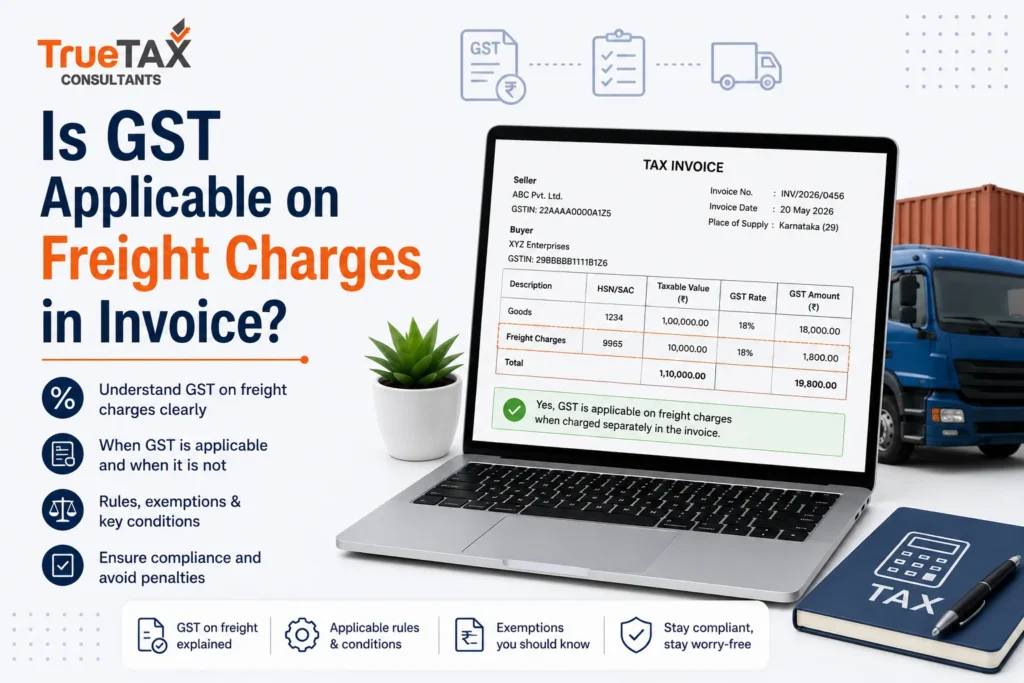
When businesses supply goods to customers, transportation costs are often added to the invoice as freight or delivery charges. Is GST Applicable on Freight Charges in Invoice? This is one of the most common questions among business owners, accountants, and GST taxpayers. The answer depends on how the freight is billed, whether it forms part of the value of goods, and the nature of the supply under GST law. Understanding these rules helps businesses prepare accurate invoices, avoid tax disputes, and remain fully compliant with GST regulations. This guide explains when GST applies to freight charges, the applicable GST rates, reverse charge provisions, exemptions, and input tax credit (ITC) eligibility for different business scenarios.
Key Takeaways
- GST is generally applicable to freight charges mentioned in an invoice.
- The GST treatment depends on whether freight is included in the value of goods or billed separately.
- Freight forming part of a composite supply attracts the same GST rate as the goods supplied.
- Separate freight charges may attract GST according to the applicable transportation service.
- Businesses should determine whether the transaction involves a Goods Transport Agency (GTA).
- Proper invoicing helps avoid GST notices, penalties, and Input Tax Credit disputes.
- Correct classification of freight charges ensures smooth GST compliance.
What Are Freight Charges?
Freight charges are the transportation costs incurred for moving goods from one location to another. These charges may include loading, unloading, packaging, handling, delivery, insurance during transit, fuel charges, toll expenses, and other logistics-related costs depending on the agreement between the buyer and the seller.
Businesses may either include freight charges within the total selling price of the goods or show them separately on the tax invoice. The GST treatment varies based on this method of billing.
For example, if a manufacturer sells machinery to a customer located in another city, the transportation cost incurred for delivering the machinery is considered a freight charge. Similarly, wholesalers, distributors, e-commerce sellers, retailers, exporters, and importers frequently recover freight charges from customers through invoices.
Why Is GST on Freight Charges Important?
Freight charges directly affect the taxable value of a transaction under GST. Incorrect treatment of freight charges can lead to:
- Incorrect GST calculation.
- Wrong tax invoices.
- Denial of Input Tax Credit (ITC).
- GST demand notices.
- Interest and penalties.
- Accounting mismatches during GST return filing.
Businesses should therefore understand when freight becomes part of the taxable value and when it is treated as an independent transportation service.
Is GST Applicable on Freight Charges in an Invoice?
Yes, GST is applicable on freight charges in an invoice in most situations. However, the manner in which GST is charged depends on how the freight is billed and the nature of the underlying transaction.
Broadly, freight charges fall into two categories:
- Freight included in the value of goods.
- Freight charged separately as an independent service.
Each situation has different GST implications.
GST When Freight Charges Are Included in the Invoice
Many businesses include transportation costs in the final selling price instead of issuing a separate freight invoice.
For example:
| Particulars | Amount |
| Product Value | ₹1,00,000 |
| Freight Charges | ₹5,000 |
| Taxable Value | ₹1,05,000 |
In this case, the freight amount becomes part of the total taxable value.
Instead of treating freight separately, GST is calculated on the complete invoice amount.
Why Is Freight Included in Taxable Value?
Under GST, the value of supply includes all expenses that the supplier incurs before delivering goods to the customer.
If the supplier is responsible for transporting the goods and recovers the freight amount from the customer, the transportation cost generally becomes part of the transaction value.
Since freight is naturally connected with the supply of goods, it is considered one component of the overall supply rather than a separate service in many business transactions.
Understanding Composite Supply
The concept of Composite Supply plays a crucial role in determining GST on freight charges.
A composite supply refers to two or more taxable supplies that are naturally bundled and supplied together in the ordinary course of business, where one supply is the principal supply and the others are ancillary.
When freight is an integral part of delivering goods, it usually forms part of a composite supply.
In such cases, the freight does not attract a separate GST rate. Instead, it follows the GST rate applicable to the principal goods being supplied.
Example of Composite Supply
Suppose a furniture manufacturer sells office desks worth ₹2,50,000 and agrees to deliver them to the customer’s office. The invoice contains:
| Particular | Amount |
| Office Desks | ₹2,50,000 |
| Freight Charges | ₹12,000 |
| Total Invoice Value | ₹2,62,000 |
If the office desks attract 18% GST, the entire invoice value of ₹2,62,000 is taxed at 18% because freight forms part of the composite supply.
The freight charge does not receive separate GST treatment.
Practical Example 1
ABC Electronics sells industrial equipment worth ₹5,00,000.
The company also charges:
- Packaging: ₹5,000
- Freight: ₹20,000
- Loading Charges: ₹3,000
Since all these charges relate to supplying the equipment to the customer, the taxable value becomes:
| Description | Amount |
| Equipment | ₹5,00,000 |
| Packaging | ₹5,000 |
| Freight | ₹20,000 |
| Loading Charges | ₹3,000 |
| Total Taxable Value | ₹5,28,000 |
If the equipment attracts 18% GST, GST is calculated on ₹5,28,000.
Practical Example 2
A tiles manufacturer delivers tiles worth ₹80,000 to a dealer.
Transportation is arranged by the supplier, and freight charges of ₹4,000 are shown on the same invoice.
The taxable value becomes:
₹80,000 + ₹4,000 = ₹84,000
GST is calculated on ₹84,000, not just the value of the tiles.
GST Rate When Freight Is Included in the Invoice
One of the biggest misconceptions among taxpayers is that freight always attracts a separate GST rate.
This is not correct.
When freight forms part of a composite supply, it follows the GST rate applicable to the principal goods.
For example:
| Goods | GST Rate | Freight GST Treatment |
| Machinery | 18% | Freight taxed at 18% |
| Furniture | 18% | Freight taxed at 18% |
| Electrical Goods | 18% | Freight taxed at 18% |
| Mobile Phones | 18% | Freight taxed at 18% |
| Solar Products | 12% | Freight taxed at 12% |
Therefore, businesses should first determine whether the freight is part of a composite supply before applying GST.
Common Business Scenarios
Different industries recover freight charges differently. Understanding these scenarios helps businesses apply the correct GST treatment.
Manufacturer Supplying Goods
A manufacturer delivers products directly to the customer’s premises and includes freight in the tax invoice. Since transportation is part of the supply of goods, GST is generally charged on the total invoice value.
Wholesaler Delivering Products
A wholesaler charges customers separately for delivery but includes the freight amount on the same invoice. If the freight is naturally linked to the sale of goods, it generally forms part of the taxable value.
Retail Supplier Offering Home Delivery
A retailer provides home delivery and collects delivery charges from customers. If the delivery service is bundled with the sale of goods, GST is generally applicable on the entire transaction value.
E-commerce Sellers
Online sellers often recover shipping charges from customers. Depending on the invoicing structure and contractual terms, these shipping charges may become part of the taxable value of the goods supplied.
GST When Freight Charges Are Charged Separately
In many business transactions, freight charges are not included in the selling price of goods. Instead, they are shown as a separate line item on the tax invoice or billed through a separate invoice. This often creates confusion among businesses regarding the applicable GST rate and whether freight should be taxed independently.
The GST treatment in such cases depends on several factors, including who provides the transportation service, whether the freight forms part of the original supply, and the contractual arrangement between the supplier and the customer.
Understanding these factors is essential to ensure correct GST calculation and compliance.
Separate Freight Charges on the Same Invoice
Businesses frequently recover transportation costs by displaying freight as a separate item on the same invoice.
For example:
| Particulars | Amount |
| Goods Value | ₹1,20,000 |
| Freight Charges | ₹8,000 |
| Total Invoice Value | ₹1,28,000 |
Although freight is shown separately, this does not automatically mean it will attract a separate GST rate.
If the supplier is responsible for delivering the goods and the freight is directly connected with the sale, it generally forms part of the value of supply. Consequently, GST is calculated on the total invoice value.
When Does Freight Become a Separate Supply?
Freight may be treated as a separate supply when transportation is provided independently of the sale of goods.
This generally occurs when:
- The buyer independently hires a transporter.
- The transporter raises a separate invoice directly to the buyer.
- Transportation is optional and not part of the supplier’s contractual obligation.
- The freight service is supplied independently of the goods.
In these situations, GST is determined according to the applicable provisions for transportation services rather than the GST rate applicable to the goods.
Separate Freight Invoice vs Combined Invoice
The way freight is invoiced significantly affects GST treatment.
Combined Invoice
Under a combined invoice:
- Goods and freight appear on the same invoice.
- Transportation is part of the sale transaction.
- Freight generally becomes part of the taxable value.
- GST is calculated on the total invoice amount.
Separate Freight Invoice
Under a separate freight invoice:
- The transporter or logistics company issues an independent invoice.
- Freight is treated as a transportation service.
- GST depends on the applicable provisions for transport services, including Goods Transport Agency (GTA) rules where applicable.
Comparison Between Combined and Separate Freight Invoices
| Particular | Combined Invoice | Separate Freight Invoice |
| Freight shown with goods | Yes | No |
| Separate transporter invoice | No | Yes |
| Freight forms part of goods | Generally Yes | Generally No |
| GST calculation | On total invoice value | Based on transportation service |
| Separate transport GST provisions | Usually not applicable | May apply |
Composite Supply vs Mixed Supply
The distinction between Composite Supply and Mixed Supply is one of the most important concepts under GST for determining the tax treatment of freight charges.
Many taxpayers incorrectly classify freight transactions, leading to inaccurate GST calculations and compliance issues.
What Is Composite Supply?
A composite supply consists of two or more taxable supplies that are naturally bundled and supplied together in the ordinary course of business.
One supply is considered the principal supply, while the remaining supplies are ancillary or incidental.
When freight is essential for delivering goods sold by the supplier, it generally becomes part of the composite supply.
Characteristics of Composite Supply
- Goods and freight are naturally bundled.
- Transportation supports the principal supply.
- Customers normally expect delivery along with the goods.
- A single commercial objective exists.
In such cases, GST is charged according to the rate applicable to the principal goods.
Example of Composite Supply
A manufacturer supplies industrial pumps worth ₹3,00,000 and arranges transportation to the customer’s factory.
Invoice:
| Particular | Amount |
| Industrial Pumps | ₹3,00,000 |
| Freight | ₹15,000 |
| Insurance | ₹2,000 |
| Total Value | ₹3,17,000 |
Since transportation and insurance are naturally connected with the sale of pumps, GST is calculated on ₹3,17,000 at the GST rate applicable to the pumps.
What Is Mixed Supply?
A mixed supply refers to two or more independent goods or services supplied together for a single price where each item can be supplied separately.
Unlike composite supply, the different items are not naturally bundled.
Mixed supply generally attracts the highest GST rate applicable among the individual supplies.
Fortunately, freight charges recovered during the normal supply of goods usually do not fall under mixed supply because transportation is generally incidental to the delivery of goods.
Composite Supply vs Mixed Supply
| Basis | Composite Supply | Mixed Supply |
| Naturally Bundled | Yes | No |
| Principal Supply | Present | Not Present |
| GST Rate | Principal Supply Rate | Highest Applicable Rate |
| Freight Example | Goods delivered by supplier | Independent bundled offers |
Understanding this distinction helps businesses apply the correct GST rate and avoid unnecessary tax disputes.
Freight Charged by Supplier vs Third-Party Transporter
Another important aspect is identifying who actually provides the transportation service.
The GST treatment differs based on whether freight is recovered by the supplier or billed directly by a transporter.
Freight Charged by Supplier
When the supplier arranges transportation and collects freight from the customer, the freight generally becomes part of the value of supply if it is incidental to the sale.
Example:
A steel manufacturer sells steel worth ₹2,00,000 and charges ₹10,000 as freight on the same invoice.
The taxable value becomes:
₹2,10,000
GST is calculated on the total amount.
Freight Charged by Third-Party Transporter
Suppose the customer directly hires a logistics company.
Invoice 1:
Goods supplied by manufacturer.
Invoice 2:
Freight billed by transporter.
Here, transportation is an independent service.
GST on freight is determined according to the applicable transportation service provisions and not according to the GST rate applicable to the goods.
GST Rate Comparison
The following table summarizes how GST is generally applied in different freight scenarios.
| Scenario | GST Treatment |
| Freight included in sale value | Same GST rate as goods |
| Freight shown separately but part of supply | Same GST rate as goods |
| Independent transportation service | GST as applicable to transport service |
| Goods delivered by supplier | Generally forms part of taxable value |
| Buyer hires transporter separately | Transportation taxed independently |
Common Mistakes Businesses Make While Charging GST on Freight
Incorrect treatment of freight charges is one of the leading reasons for GST notices and reconciliation issues. Some common mistakes include:
- Charging a separate GST rate on freight even when it forms part of a composite supply.
- Excluding freight from the taxable value despite being responsible for delivery.
- Incorrectly treating transportation as an independent supply.
- Applying Goods Transport Agency (GTA) provisions where they are not applicable.
- Using the wrong SAC code for freight services.
- Issuing incorrect tax invoices.
- Claiming Input Tax Credit without verifying eligibility.
- Ignoring contractual terms related to delivery and transportation.
Businesses should evaluate each transaction individually before deciding the GST treatment of freight charges.
Best Practices for GST Compliance on Freight Charges
Following proper GST practices helps businesses avoid penalties and ensures smooth compliance.
Some recommended practices include:
- Clearly define delivery terms in sales agreements.
- Determine whether freight forms part of the value of supply.
- Maintain proper freight invoices and supporting documents.
- Verify whether transportation qualifies as an independent service.
- Apply the correct GST rate based on the nature of the transaction.
- Reconcile freight charges with GST returns regularly.
- Keep updated with the latest GST notifications and CBIC circulars.
Proper documentation and accurate invoicing reduce the risk of GST disputes during departmental assessments.
Need Professional Assistance with GST Compliance?
Determining the correct GST treatment of freight charges can be challenging, especially when dealing with composite supplies, transportation contracts, and invoice structuring. Incorrect GST calculations may result in notices, penalties, or denial of Input Tax Credit.
TrueTax Consultants Bangalore offers comprehensive GST services, including GST registration, return filing, GST advisory, invoice review, Input Tax Credit assistance, GST notices, GST audits, and compliance support. Our experienced professionals help businesses apply the correct GST provisions, prepare accurate tax invoices, and remain fully compliant with the latest GST regulations.
Conclusion
GST is generally applicable to freight charges mentioned in an invoice, but the exact tax treatment depends on the nature of the transaction. When freight is connected with the supply of goods and forms part of a composite supply, it usually attracts the same GST rate as the goods. However, when transportation is supplied independently through a separate transporter, the freight may be taxed according to the applicable GST provisions for transportation services.
Understanding the distinction between freight included in the invoice and independent transportation services enables businesses to issue accurate invoices, claim eligible Input Tax Credit, and maintain full compliance with GST laws. Careful evaluation of each transaction, supported by proper documentation, is the key to avoiding future tax disputes and ensuring smooth GST compliance.