
India’s Goods and Services Tax (GST) system revolutionized indirect taxation by replacing multiple central and state taxes with a unified framework. Introduced on 1 July 2017, GST simplified tax compliance, improved transparency, and enabled businesses to claim seamless Input Tax Credit (ITC) throughout the supply chain.
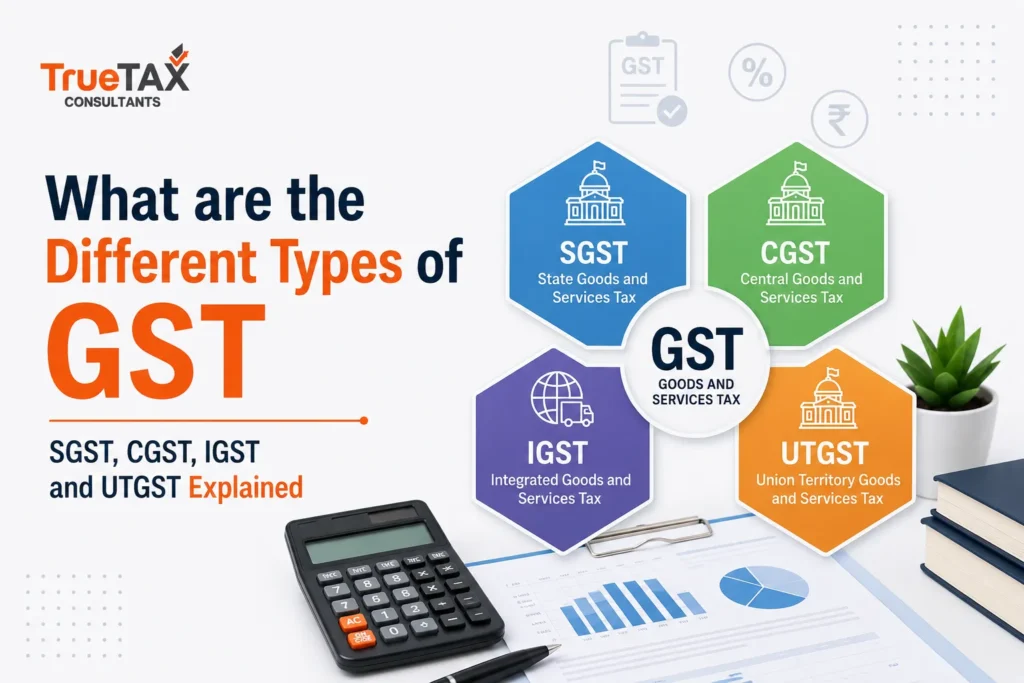
Although GST is often referred to as a single tax, it consists of four distinct components—CGST, SGST, IGST, and UTGST. These components determine how tax is levied, collected, and distributed between the Central Government, State Governments, and Union Territories.
For businesses, startups, e-commerce sellers, manufacturers, service providers, importers, exporters, and tax professionals, understanding the different types of GST is critical. Applying the wrong GST component can result in incorrect invoicing, tax payment errors, ITC mismatches, GST notices, and penalties.
This comprehensive guide explains the meaning, applicability, examples, calculations, and differences between SGST, CGST, IGST, and UTGST in detail.
Key Takeaways
- GST in India is divided into CGST, SGST, IGST, and UTGST.
- The applicable GST component depends on whether the transaction is intra-state or inter-state.
- CGST is collected by the Central Government.
- SGST is collected by State Governments.
- UTGST is collected in Union Territories without legislatures.
- IGST applies to interstate supplies, imports, exports, and SEZ transactions.
- GST follows a destination-based taxation model.
- Correct GST classification helps businesses claim Input Tax Credit properly and remain compliant.
What is GST?
GST (Goods and Services Tax) is a comprehensive indirect tax levied on the supply of goods and services across India. It replaced multiple indirect taxes imposed by the Central and State Governments and established a unified taxation framework designed to simplify compliance and improve tax efficiency.
GST is charged at every stage of the supply chain, from manufacturing and distribution to final consumption. However, because businesses can claim Input Tax Credit on purchases, the tax burden ultimately falls on the end consumer.
Taxes Replaced by GST
Before GST, businesses had to comply with multiple indirect taxes such as:
Central Taxes
- Central Excise Duty
- Service Tax
- Additional Excise Duty
- Countervailing Duty (CVD)
- Special Additional Duty (SAD)
State Taxes
- Value Added Tax (VAT)
- Luxury Tax
- Entertainment Tax
- Entry Tax
- Purchase Tax
- Advertisement Tax
- Octroi
The GST regime consolidated these taxes under a single tax structure.
Why Was GST Introduced?
Before GST, India’s indirect tax system was fragmented and complex.
Businesses frequently faced challenges such as:
- Multiple tax registrations
- Different state-level tax laws
- Cascading tax effects
- Limited credit availability
- Increased logistics costs
- Complex return filing requirements
To address these challenges, the Government introduced GST.
Objectives of GST
The Goods and Services Tax (GST) was introduced with several key objectives aimed at transforming India’s indirect tax system and creating a more efficient business environment. These objectives include:
- Create a Unified National Market: GST removed multiple state-level tax barriers, enabling the free movement of goods and services across India and fostering seamless interstate trade.
- Eliminate Tax Cascading: Through the Input Tax Credit (ITC) mechanism, businesses can claim credit for taxes paid on purchases, preventing the “tax on tax” effect.
- Improve Ease of Doing Business: A standardized tax structure and common compliance procedures reduce complexity and administrative burdens for businesses.
- Increase Transparency: GST introduced digital processes such as online registration, return filing, e-invoicing, and electronic record-keeping, improving accountability.
- Strengthen Tax Collection: Technology-driven compliance systems help minimize tax evasion, broaden the tax base, and enhance government revenue collection.
What are the Different Types of GST in India
India follows a dual GST model that divides tax collection between the Central Government, State Governments, and Union Territories. To facilitate efficient tax administration and revenue sharing, GST is classified into CGST, SGST, IGST, and UTGST.
The four types of GST applicable in India are:
- CGST (Central Goods and Services Tax): Collected by the Central Government on the supply of goods and services within the same state (intra-state transactions).
- SGST (State Goods and Services Tax): Collected by the respective State Government on intra-state supplies of goods and services.
- IGST (Integrated Goods and Services Tax): Levied on inter-state transactions, imports, exports, and supplies involving Special Economic Zones (SEZs).
- UTGST (Union Territory Goods and Services Tax): Applicable to intra-union territory supplies in Union Territories that do not have their own legislature.
Each GST component serves a specific purpose in India’s taxation framework, ensuring proper revenue sharing between the Central Government, State Governments, and Union Territories.
How to Determine the Applicable GST Type?
The applicable GST type depends on the location of the supplier, place of supply, and nature of the transaction. Correctly identifying whether a supply is intra-state or inter-state helps businesses charge the appropriate GST component.
Incorrect classification may lead to:
- Wrong GST payment
- Input Tax Credit disputes
- GST notices
- Interest liability
- Penalties
- Return mismatches
Therefore, determining the correct GST component is one of the most important aspects of GST compliance.
Step 1: Identify the Supplier’s Location
Determine where the supplier is registered under GST.
Examples:
- Maharashtra
- Karnataka
- Tamil Nadu
- Delhi
The supplier’s registration location is the first factor in GST classification.
Step 2: Determine the Place of Supply
Place of Supply refers to the location where goods or services are consumed.
It plays a critical role in determining whether GST should be charged as:
- CGST + SGST
or - CGST + UTGST
or - IGST
For service providers, Place of Supply provisions become particularly important because the supplier and recipient may be located in different states.
Step 3: Classify the Transaction
Intra-State Supply
When the supplier and place of supply are located in the same state or union territory.
Applicable Taxes:
- CGST + SGST
or - CGST + UTGST
Example
Supplier: Bengaluru, Karnataka
Buyer: Mysuru, Karnataka
Applicable GST:
- CGST @9%
- SGST @9%
Total GST = 18%
Inter-State Supply
When the supplier and place of supply are located in different states or union territories.
Applicable Tax:
- IGST
Example
Supplier: Mumbai, Maharashtra
Buyer: Ahmedabad, Gujarat
Applicable GST:
- IGST @18%
Understanding GST as a Destination-Based Tax
GST is known as a destination-based tax because the tax revenue ultimately belongs to the state where goods or services are consumed rather than where they are produced.
This principle represents one of the most important features of India’s GST framework.
Why is GST Called a Destination-Based Tax?
Under the earlier taxation system, manufacturing states often received a larger share of tax revenue.
GST shifted the focus from production to consumption.
As a result:
- Consuming states receive tax revenue.
- Interstate trade becomes more efficient.
- Revenue allocation becomes more equitable.
Example of Destination-Based Taxation
Suppose:
- Goods are manufactured in Gujarat.
- Sold to a distributor in Maharashtra.
- Consumed by customers in Maharashtra.
Although manufacturing took place in Gujarat, GST revenue ultimately belongs to Maharashtra because the final consumption occurred there.
Benefits of Destination-Based Taxation
Destination-based taxation under GST ensures that tax revenue is collected by the state or union territory where goods or services are ultimately consumed. This approach provides several important benefits, including:
- Fair Revenue Distribution: States receive GST revenue based on actual consumption within their jurisdiction, ensuring a more equitable allocation of tax collections.
- Improved Interstate Trade: Businesses can operate and expand across state borders more easily, as GST eliminates many of the tax barriers that previously hindered interstate commerce.
- Better Tax Administration: GST settlement mechanisms facilitate the accurate distribution of tax revenue between the Centre and states, improving overall tax governance.
- Increased Transparency: The seamless flow of Input Tax Credit (ITC) makes tax transactions more traceable, reducing leakages and enhancing compliance.
What is IGST? Full Form, Meaning and Applicability
Integrated Goods and Services Tax (IGST) is charged on inter-state supplies of goods and services, imports, exports, and SEZ transactions. It enables seamless tax credit flow across states while ensuring the destination state receives its share of GST revenue.
IGST Full Form
IGST stands for Integrated Goods and Services Tax.
It is governed by the Integrated Goods and Services Tax Act, 2017 and is applicable whenever a transaction involves movement of goods or services across state boundaries.
Why Was IGST Introduced?
Before GST, interstate transactions attracted Central Sales Tax (CST), which often created compliance difficulties and restricted tax credit flow.
The introduction of IGST solved these challenges by:
- Simplifying interstate taxation
- Enabling seamless Input Tax Credit
- Reducing cascading taxes
- Supporting interstate commerce
- Improving tax administration
When is IGST Applicable?
IGST applies in several situations.
Inter-State Supply of Goods
Example:
Supplier in Maharashtra
Buyer in Gujarat
Applicable Tax:
- IGST
Inter-State Supply of Services
Example:
Consultant in Karnataka
Client in Delhi
Applicable Tax:
- IGST
Imports into India
All imports are treated as inter-state supplies under GST.
Applicable Taxes:
- Customs Duty
- IGST
Exports from India
Exports are considered zero-rated supplies.
Businesses may:
- Export under LUT without payment of IGST.
- Pay IGST and claim refund.
SEZ Transactions
Supplies made to or by a Special Economic Zone (SEZ) are treated as inter-state supplies regardless of location.
Key Features of IGST
Single Tax Collection
Instead of charging CGST and SGST separately, only IGST is charged.
Seamless ITC Flow
Businesses can transfer tax credits efficiently across state boundaries.
Revenue Sharing Mechanism
The Central Government collects IGST and later apportions the relevant share to the destination state.
Reduced Compliance Burden
Businesses dealing with interstate transactions face fewer tax complications.
IGST Example with Calculation
Assume:
Supplier: Chandigarh
Buyer: Dadra & Nagar Haveli and Daman & Diu
Value of Goods: ₹1,00,000
GST Rate: 18%
| Particulars | Amount |
| Value of Goods | ₹1,00,000 |
| IGST @18% | ₹18,000 |
| Total Invoice Value | ₹1,18,000 |
The supplier collects ₹18,000 as IGST and deposits it with the Central Government.
The tax is later apportioned between the Centre and the destination state or Union Territory.
Common Business Transactions Where IGST Applies
- Interstate sale of goods
- Interstate service contracts
- E-commerce sales across states
- Export transactions
- Import transactions
- Supplies to SEZ units
- Online software subscriptions purchased from foreign vendors
- Cross-border service transactions
Common Mistakes Businesses Make with IGST
Businesses often face GST compliance challenges due to errors in the application and reporting of IGST. Some of the most common mistakes include:
- Charging CGST and SGST Instead of IGST: Applying the wrong tax components on interstate transactions can result in incorrect tax payments and compliance issues.
- Incorrect Place of Supply Determination: Misidentifying the place of supply may lead to the wrong classification of transactions as intra-state or inter-state.
- Wrong GSTIN Usage: Using an incorrect GST Identification Number (GSTIN) can cause return mismatches and difficulties in claiming Input Tax Credit (ITC).
- Incorrect Treatment of Exports: Failing to properly classify exports as zero-rated supplies may lead to errors in tax payment and refund claims.
- Failure to Reconcile Interstate Transactions: Differences between invoices, GST returns, and accounting records can trigger notices from tax authorities.
- Improper Input Tax Credit Claims: Claiming ITC incorrectly on IGST-paid purchases may result in penalties, reversals, and compliance complications.
These errors frequently lead to GST notices, tax disputes, delayed refunds, and additional compliance burdens for businesses.
What is CGST? Full Form, Meaning and Applicability
Central Goods and Services Tax (CGST) is the portion of GST collected by the Central Government on intra-state supplies. It is charged together with SGST or UTGST and helps the Centre receive its share of indirect tax revenue.
CGST Full Form
CGST stands for Central Goods and Services Tax.
It is the tax levied by the Central Government on the intra-state supply of goods and services. Whenever a transaction occurs within the same state or union territory, GST is generally divided equally between CGST and SGST or CGST and UTGST.
CGST is governed by the Central Goods and Services Tax Act, 2017 (CGST Act) and forms one-half of the GST charged on intra-state transactions.
For example, if the applicable GST rate is 18%, it is usually split as:
- CGST = 9%
- SGST = 9%
or
- CGST = 9%
- UTGST = 9%
This ensures that both the Central Government and the State Government or Union Territory receive their respective share of GST revenue.
Why Was CGST Introduced?
Before GST, the Central Government levied and collected several indirect taxes independently.
These included:
- Central Excise Duty
- Service Tax
- Additional Excise Duties
- Additional Customs Duties
- Special Additional Duties
Each tax had separate compliance requirements, return filing procedures, and assessment mechanisms.
CGST was introduced to:
- Consolidate multiple central taxes into one framework.
- Simplify indirect tax administration.
- Improve tax compliance.
- Facilitate seamless credit flow.
- Reduce cascading taxes.
- Support the “One Nation, One Tax” objective.
Today, CGST acts as the Central Government’s share of GST revenue from domestic transactions occurring within a state.
Key Features of CGST
Levied by the Central Government
CGST is administered and collected by the Central Government through the GST system.
Applicable on Intra-State Supplies
CGST applies only when the supplier and place of supply are located within the same state or union territory.
Charged Alongside SGST or UTGST
CGST is always accompanied by either:
- SGST
or - UTGST
Uniform Legal Framework
The CGST Act applies consistently across India, providing a uniform compliance structure.
Supports Input Tax Credit
Businesses can claim credit of CGST paid on eligible purchases and use it against specified GST liabilities.
When Does CGST Apply?
CGST applies whenever goods or services are supplied within the same state.
Example 1: Sale of Goods Within Karnataka
Supplier: Bengaluru
Buyer: Mysuru
GST Rate: 18%
Applicable Taxes:
- CGST = 9%
- SGST = 9%
Example 2: Service Supply Within Maharashtra
Digital Marketing Agency: Pune
Client: Mumbai
GST Rate: 18%
Applicable Taxes:
- CGST = 9%
- SGST = 9%
Example 3: Retail Sale Within Tamil Nadu
Retail Store: Chennai
Customer: Coimbatore
Applicable Taxes:
- CGST
- SGST
Because both supplier and customer are located within Tamil Nadu.
CGST Calculation Example
Suppose a business sells goods worth ₹1,00,000 within the same state.
GST Rate = 18%
Calculation:
| Particulars | Amount |
| Value of Goods | ₹1,00,000 |
| CGST @9% | ₹9,000 |
| SGST @9% | ₹9,000 |
| Total GST | ₹18,000 |
| Invoice Value | ₹1,18,000 |
Revenue Distribution:
- Central Government receives ₹9,000 as CGST.
- State Government receives ₹9,000 as SGST.
Input Tax Credit (ITC) Under CGST
Input Tax Credit is one of the most significant benefits available under GST.
Businesses can claim credit for GST paid on purchases used for business purposes and offset this credit against future GST liabilities.
Utilisation of CGST Credit
CGST credit can be used in the following order:
First Priority
Against CGST liability.
Second Priority
Against IGST liability.
Restriction
CGST credit cannot be directly utilised against SGST liability.
Example of CGST ITC Utilisation
Available CGST Credit = ₹20,000
CGST Liability = ₹12,000
IGST Liability = ₹10,000
Adjustment:
- ₹12,000 used against CGST liability.
- Remaining ₹8,000 adjusted against IGST liability.
Balance IGST Payable:
₹2,000
Benefits of CGST
CGST provides several advantages to businesses and the government.
Simplified Tax Administration
A single framework replaces multiple central taxes.
Better Compliance
Uniform regulations reduce confusion and compliance burden.
Seamless ITC Flow
Businesses can claim tax credits efficiently.
Improved Transparency
Digital compliance systems make tax reporting easier.
Reduced Tax Cascading
Input tax credit prevents tax-on-tax situations.
What is SGST? Full Form, Meaning and Applicability
State Goods and Services Tax (SGST) is levied by State Governments on intra-state transactions. It is charged alongside CGST on supplies occurring within a state and forms an important source of revenue for state governments.
SGST Full Form
SGST stands for State Goods and Services Tax.
It represents the share of GST collected by State Governments on intra-state supplies of goods and services.
Whenever a transaction occurs within the same state, GST is generally split equally between:
- CGST
- SGST
This ensures that both the Central Government and the State Government receive tax revenue from the transaction.
Why Was SGST Introduced?
Prior to GST, State Governments collected numerous indirect taxes independently.
These included:
- VAT (Value Added Tax)
- Luxury Tax
- Entertainment Tax
- Entry Tax
- Purchase Tax
- Advertisement Tax
- Betting and Gambling Tax
The introduction of SGST consolidated these taxes into a single system.
As a result:
- Compliance became easier.
- Tax administration improved.
- Businesses faced fewer tax complexities.
- States continued receiving indirect tax revenue.
Key Features of SGST
Levied by State Governments
SGST is imposed by the state in which the supply occurs.
Applicable on Intra-State Transactions
It applies only when the supplier and place of supply are within the same state.
Charged Together with CGST
SGST is not charged independently.
It always accompanies CGST.
Revenue Belongs to the State
The tax collected under SGST is retained by the respective State Government.
ITC Available
Businesses can claim Input Tax Credit on SGST paid on eligible purchases.
Taxes Replaced by SGST
Following GST implementation, SGST absorbed several state-level taxes.
Value Added Tax (VAT)
One of the most significant taxes replaced by GST.
Luxury Tax
Previously applicable to luxury services and accommodations.
Entertainment Tax
Levied on movie tickets and entertainment activities.
Entry Tax
Charged on goods entering a state.
Purchase Tax
Applicable on specific purchases under state laws.
Advertisement Tax
Collected by certain local authorities before GST.
When Does SGST Apply?
SGST applies whenever the supplier and recipient are located within the same state.
Example
Supplier: Hyderabad
Buyer: Warangal
State: Telangana
Applicable Taxes:
- CGST
- SGST
Since both parties are located within Telangana.
SGST Calculation Example
Suppose:
Value of Goods = ₹50,000
GST Rate = 18%
Calculation:
| Particulars | Amount |
| Value of Goods | ₹50,000 |
| CGST @9% | ₹4,500 |
| SGST @9% | ₹4,500 |
| Total GST | ₹9,000 |
| Invoice Value | ₹59,000 |
Revenue Distribution:
- Central Government receives ₹4,500.
- Telangana Government receives ₹4,500.
Importance of SGST for State Governments
State Governments depend heavily on SGST collections for public spending and development initiatives.
SGST revenue supports:
Infrastructure Development
- Roads
- Bridges
- Public transport systems
Healthcare Services
- Government hospitals
- Medical schemes
- Public health initiatives
Education
- Government schools
- Universities
- Scholarship programs
Welfare Programs
- Social welfare initiatives
- Rural development schemes
- State subsidies
Input Tax Credit Under SGST
Businesses can claim SGST credit on eligible purchases.
Utilisation Order
SGST credit can be used:
First
Against SGST liability.
Then
Against IGST liability.
Restriction
SGST credit cannot be directly used against CGST liability.
Example of SGST ITC Utilisation
Available SGST Credit = ₹15,000
SGST Liability = ₹10,000
IGST Liability = ₹7,000
Adjustment:
- ₹10,000 used against SGST liability.
- Remaining ₹5,000 adjusted against IGST liability.
Balance IGST Payable:
₹2,000
CGST and SGST Example
One of the most common GST scenarios involves charging CGST and SGST together on intra-state transactions.
Let us understand this with a practical example.
Seller
Rajesh Ltd., Chhattisgarh
Buyer
Vijay Ltd., Chhattisgarh
Value of Goods
₹10,000
GST Rate
18%
Since both businesses are located within Chhattisgarh, the transaction qualifies as an intra-state supply.
Calculation:
| Particulars | Amount |
| Value of Goods | ₹10,000 |
| CGST @9% | ₹900 |
| SGST @9% | ₹900 |
| Total GST | ₹1,800 |
| Invoice Value | ₹11,800 |
Revenue Distribution:
- ₹900 goes to the Central Government.
- ₹900 goes to the Chhattisgarh Government.
This example demonstrates how GST revenue is shared between the Centre and State when a supply occurs within the same state.
Why Are CGST and SGST Charged Separately?
Many taxpayers wonder why GST is split into two components instead of charging a single tax.
The answer lies in India’s constitutional framework.
India follows a federal system where both:
- Central Government
- State Governments
India’s dual GST model allows both the Central and State Governments to levy and collect taxes on intra-state transactions. This structure offers several significant advantages, including:
- Fair Revenue Sharing: Both the Central Government and State Governments receive their respective share of GST revenue, ensuring balanced distribution of tax collections.
- Fiscal Independence: States continue to maintain an important and stable source of revenue, supporting their financial autonomy and development initiatives.
- Simplified Compliance: Businesses benefit from a unified GST framework while tax revenue is efficiently shared between different levels of government.
- Efficient Tax Administration: The GST system provides a transparent and systematic mechanism for tax collection, reporting, and revenue allocation.
- Better Governance: Consistent revenue streams enable both the Centre and states to fund infrastructure projects, welfare programs, and essential public services more effectively.
Common Business Mistakes Related to CGST and SGST
Businesses often make mistakes that result in GST notices and compliance issues.
Common errors include:
- Charging IGST instead of CGST and SGST.
- Incorrect Place of Supply determination.
- Using the wrong GST registration.
- Claiming ineligible Input Tax Credit.
- Mismatches between GSTR-1 and GSTR-3B.
- Incorrect invoice classification.
- Failure to reconcile books with GST returns.
- Wrong tax treatment of services.
Understanding CGST and SGST applicability is therefore essential for accurate GST compliance and avoiding unnecessary disputes.
What is UTGST? Full Form, Meaning and Applicability
Union Territory Goods and Services Tax (UTGST) applies to intra-union territory supplies in territories without a legislature. It is charged together with CGST and ensures Union Territories receive their share of GST collections and revenue.
UTGST Full Form
UTGST stands for Union Territory Goods and Services Tax.
UTGST is similar to SGST, but instead of applying to states, it applies to certain Union Territories that do not have their own legislative assembly.
Whenever a taxable supply takes place within an eligible Union Territory, GST is divided into:
- CGST
- UTGST
Just like CGST and SGST are charged together in states, CGST and UTGST are charged together in applicable Union Territories.
UTGST is governed by the Union Territory Goods and Services Tax Act, 2017.
Why Was UTGST Introduced?
India consists of both States and Union Territories. While some Union Territories have their own legislature, others are administered directly by the Central Government.
To ensure that these Union Territories continue receiving their share of GST revenue, UTGST was introduced as a separate GST component.
The introduction of UTGST helps:
- Maintain revenue distribution.
- Simplify tax administration.
- Create uniform GST compliance.
- Ensure fair allocation of indirect tax revenue.
- Support development activities in Union Territories.
Union Territories Covered Under UTGST
UTGST applies in Union Territories that do not have a legislature.
These include:
Andaman and Nicobar Islands
A strategically important island territory administered by the Central Government.
Chandigarh
A Union Territory serving as the capital of Punjab and Haryana.
Dadra and Nagar Haveli and Daman and Diu
A merged Union Territory governed directly by the Centre.
Lakshadweep
India’s smallest Union Territory by area.
Ladakh
A Union Territory formed after the reorganization of Jammu and Kashmir.
Union Territories Where SGST Applies Instead of UTGST
Certain Union Territories have their own legislature and therefore follow SGST provisions rather than UTGST.
These include:
Delhi
National Capital Territory of Delhi.
Puducherry
A Union Territory with its own elected legislative assembly.
Jammu and Kashmir
Although a Union Territory, GST is administered under SGST provisions.
When Does UTGST Apply?
UTGST applies when:
- Supplier is located in an eligible Union Territory.
- Place of supply is within the same Union Territory.
In such cases:
- CGST is charged.
- UTGST is charged.
UTGST Example
Suppose a business located in Chandigarh sells goods worth ₹1,00,000 to a customer within Chandigarh.
GST Rate = 18%
Applicable Taxes:
- CGST = 9%
- UTGST = 9%
Calculation:
| Particulars | Amount |
| Value of Goods | ₹1,00,000 |
| CGST @9% | ₹9,000 |
| UTGST @9% | ₹9,000 |
| Total GST | ₹18,000 |
| Invoice Value | ₹1,18,000 |
Revenue Distribution:
- Central Government receives ₹9,000.
- Chandigarh Administration receives ₹9,000.
Input Tax Credit Under UTGST
Businesses registered in Union Territories can claim ITC on UTGST paid on purchases.
Utilisation Order of UTGST Credit
UTGST credit can be used:
First
Against UTGST liability.
Then
Against IGST liability.
Restriction
UTGST credit cannot be directly utilised against CGST liability.
This utilisation mechanism is similar to SGST credit rules.
Importance of UTGST
UTGST plays a crucial role in maintaining GST uniformity across India.
Key benefits include:
Revenue Allocation
Ensures Union Territories receive their appropriate share of GST.
Consistent Tax Framework
Maintains parity with the SGST structure used in states.
Simplified Compliance
Businesses operating in Union Territories follow the same GST framework.
Better Governance
Supports development and public welfare initiatives within Union Territories.
Why Are There Different Types of GST?
India’s federal structure requires both the Central and State Governments to collect tax revenue. The GST system uses multiple tax components to ensure fair revenue distribution, smooth tax credit flow, and efficient administration nationwide.
One of the most common questions among taxpayers is:
Why does GST have four different components instead of a single tax?
The answer lies in India’s constitutional and administrative framework.
India’s Federal Tax Structure
India follows a federal system of governance.
Under the Constitution:
- The Central Government has taxation powers.
- State Governments also have taxation powers.
Before GST, both levels of government independently imposed indirect taxes.
The GST model was designed to preserve these constitutional powers while creating a unified tax structure.
Revenue Sharing Between Centre and States
Both the Central Government and State Governments require revenue to perform their responsibilities.
Central Government Responsibilities
- Defence
- Railways
- National highways
- Foreign affairs
- National infrastructure projects
State Government Responsibilities
- Healthcare
- Education
- Police administration
- Local infrastructure
- Public welfare programs
The GST framework ensures that both governments continue receiving tax revenue.
Supporting “One Nation, One Tax”
Although GST consists of multiple components, it functions as a unified tax system.
The structure ensures:
- Uniform tax rates.
- Common compliance procedures.
- Seamless ITC flow.
- Simplified interstate trade.
This balance between unity and revenue sharing is one of the key strengths of GST.
How to Check GST Applicability?
The applicable GST type depends on the nature of the transaction.
Businesses must determine:
- Location of supplier.
- Place of supply.
- Nature of goods or services.
- Customer location.
Incorrect classification can lead to:
- Wrong tax payment.
- ITC denial.
- Interest liability.
- GST notices.
Step 1: Determine Supplier Location
Identify the GST registration under which the supply is being made.
Step 2: Determine Place of Supply
Place of Supply provisions help identify where goods or services are consumed.
This is one of the most important concepts under GST.
Step 3: Compare Both Locations
Same State
Applicable Taxes:
- CGST + SGST
or
- CGST + UTGST
Different States
Applicable Tax:
- IGST
Step 4: Verify GST Registration Details
Businesses should verify GSTINs before issuing invoices.
Benefits include:
- Correct tax application.
- Reduced compliance risks.
- Better return accuracy.
- Prevention of fraudulent transactions.
How is ITC Offset Done?
Input Tax Credit allows businesses to reduce their GST liability by claiming credit for taxes paid on purchases. Understanding ITC utilisation rules for CGST, SGST, IGST, and UTGST is essential for accurate GST compliance.
Input Tax Credit is one of the most valuable features of GST.
Without ITC, businesses would suffer from cascading taxation.
What is Input Tax Credit?
Input Tax Credit refers to the GST paid on business purchases that can be adjusted against GST payable on sales.
This ensures tax is imposed only on value addition.
Order of ITC Utilisation
GST law prescribes a specific order for utilising tax credits.
IGST Credit Utilisation
IGST credit should first be used against:
- IGST liability
- CGST liability
- SGST/UTGST liability
CGST Credit Utilisation
CGST credit should be used against:
- CGST liability
- IGST liability
SGST Credit Utilisation
SGST credit should be used against:
- SGST liability
- IGST liability
UTGST Credit Utilisation
UTGST credit should be used against:
- UTGST liability
- IGST liability
Detailed ITC Example
Consider the following supply chain.
Manufacturer A (Maharashtra)
Sells goods worth ₹10,000 to Dealer B.
Applicable Taxes:
- CGST = ₹900
- SGST = ₹900
Dealer B (Maharashtra)
Resells goods to Trader C in Rajasthan for ₹17,500.
Applicable Tax:
- IGST @18% = ₹3,150
Dealer B can claim ITC on CGST and SGST paid earlier.
Trader C (Rajasthan)
Sells goods to final customer for ₹30,000.
Applicable Taxes:
- CGST = ₹2,700
- SGST = ₹2,700
The ITC mechanism ensures tax is charged only on value addition at each stage.
How is GST Collected?
GST collection follows a systematic process involving suppliers, recipients, governments, and GSTN infrastructure.
Step 1: Supplier Charges GST
The seller issues a GST invoice.
Applicable tax depends on transaction type:
- CGST + SGST
- CGST + UTGST
- IGST
Step 2: Tax is Deposited
The supplier deposits GST through the GST portal.
Step 3: Returns Are Filed
Businesses report transactions through GST returns.
Examples:
- GSTR-1
- GSTR-3B
Step 4: ITC Matching and Settlement
The GST Network (GSTN) facilitates credit matching and revenue settlement.
Step 5: Revenue Allocation
Revenue is distributed among:
- Central Government
- State Governments
- Union Territories
based on GST rules.
Difference Between CGST, SGST, IGST and UTGST
Each GST component serves a distinct purpose within India’s taxation framework. Understanding the differences between CGST, SGST, IGST, and UTGST helps businesses determine the correct tax to charge, claim ITC properly, and maintain compliance.
| Particulars | CGST | SGST | IGST | UTGST |
| Full Form | Central Goods and Services Tax | State Goods and Services Tax | Integrated Goods and Services Tax | Union Territory Goods and Services Tax |
| Levied By | Central Government | State Government | Central Government | Union Territory Administration |
| Applicability | Intra-State Supply | Intra-State Supply | Inter-State Supply | Intra-UT Supply |
| Revenue Recipient | Centre | State | Centre & Destination State | Union Territory |
| Charged With | SGST/UTGST | CGST | Standalone | CGST |
| ITC Utilisation | CGST → IGST | SGST → IGST | IGST → CGST → SGST/UTGST | UTGST → IGST |
Common Mistakes Businesses Make While Applying GST Types
Businesses frequently make GST classification errors that result in notices and penalties.
Common mistakes include:
- Charging CGST and SGST instead of IGST.
- Incorrect place of supply determination.
- Wrong GSTIN usage.
- Improper ITC utilisation.
- Failure to reconcile GST returns.
- Wrong treatment of SEZ transactions.
- Incorrect export reporting.
- Errors in e-commerce supplies.
- Inaccurate invoice preparation.
- Failure to verify customer registration details.
These mistakes often lead to compliance challenges and unnecessary tax disputes.
Conclusion
We have covered detailed guide on different Types of GST. India’s GST system consists of four major components—CGST, SGST, IGST, and UTGST. Each component plays an important role in ensuring proper tax collection, revenue sharing, and seamless Input Tax Credit flow throughout the economy.
Understanding the applicability of different GST types is essential for businesses of all sizes. Whether dealing with local sales, interstate transactions, imports, exports, e-commerce supplies, or Union Territory operations, selecting the correct GST component helps ensure compliance, avoid penalties, and maintain accurate tax records.
By understanding how CGST, SGST, IGST, and UTGST work together, businesses can improve GST compliance, maximize Input Tax Credit benefits, and confidently manage their indirect tax obligations.
Need Expert GST Registration and Compliance Support?
Managing GST can be challenging, especially when it comes to determining the correct GST type, claiming Input Tax Credit, filing returns accurately, and staying compliant with evolving GST regulations. Even a small error in GST classification or return filing can lead to notices, penalties, interest charges, and unnecessary compliance hassles.
At TrueTax Consultants Bangalore, our GST experts help businesses, startups, freelancers, traders, manufacturers, service providers, and e-commerce sellers manage their GST obligations with confidence. From GST registration and return filing to GST notice handling and advisory services, we provide end-to-end support tailored to your business needs.
Our GST Services Include:
- GST Registration and Amendment Services
- GST Return Filing (GSTR-1, GSTR-3B, GSTR-9, and GSTR-9C)
- GST Consultation and Advisory
- GST Notice and Assessment Support
- Input Tax Credit (ITC) Review and Reconciliation
- GST Compliance Management
- E-Invoicing and E-Way Bill Assistance
- GST for Startups and Small Businesses
- GST for E-Commerce Sellers
- GST Audit Support
- Import and Export GST Advisory
- GST Registration Cancellation and Revocation
Whether you are applying for a new GST registration, filing monthly GST returns, resolving GST notices, or seeking expert GST consultation, TrueTax Consultants Bangalore can help you stay compliant and focus on growing your business.
Get in touch with TrueTax Consultants Bangalore today for reliable GST registration, GST return filing, GST compliance, and tax advisory services tailored to your business requirements.
FAQs
What are the taxes levied on an intra-state supply?
For an intra-state supply, GST is divided into two equal components. In states, the applicable taxes are CGST and SGST, while in eligible Union Territories, CGST and UTGST are charged. For example, if a product attracts GST at 18%, it is generally split into 9% CGST and 9% SGST or UTGST. This mechanism ensures that both the Central Government and the State Government or Union Territory Administration receive their share of tax revenue.
What are the 4 types of GST in India?
The four types of GST in India are CGST (Central Goods and Services Tax), SGST (State Goods and Services Tax), IGST (Integrated Goods and Services Tax), and UTGST (Union Territory Goods and Services Tax). Each GST component serves a specific purpose within India’s dual GST model. CGST and SGST/UTGST apply to intra-state transactions, while IGST applies to inter-state transactions, imports, exports, and supplies involving Special Economic Zones (SEZs).
What tax is charged on an inter-state supply?
IGST, or Integrated Goods and Services Tax, is charged on inter-state supplies of goods and services. A transaction is considered inter-state when the supplier and the place of supply are located in different states or Union Territories. IGST is also applicable to imports, exports, and supplies made to or by SEZ units. Instead of charging CGST and SGST separately, a single IGST amount is collected and later apportioned between the Centre and the destination state.
What is the maximum rate at which IGST can be levied?
Under the IGST Act, the maximum rate at which IGST can be levied may extend up to 40%, subject to recommendations of the GST Council and government notifications. However, in practical scenarios, most goods and services fall under standard GST slabs such as 5%, 12%, 18%, and 28%. The applicable IGST rate is generally equal to the combined rate of CGST and SGST charged on similar intra-state supplies.
How is GST divided between Centre and State?
For intra-state transactions, GST is shared equally between the Central Government and the State Government. The Central Government receives the CGST portion, while the State Government receives the SGST portion. In the case of inter-state transactions, IGST is initially collected by the Central Government and later distributed between the Centre and the destination state based on GST settlement rules. This ensures that tax revenue reaches the state where goods or services are ultimately consumed.
What happens if the wrong GST type is charged?
Charging the wrong GST type can create significant compliance challenges. For example, if a business incorrectly charges CGST and SGST instead of IGST on an interstate transaction, it may need to pay the correct tax along with applicable interest. Such errors can also lead to Input Tax Credit mismatches, GST notices, delayed refunds, and additional compliance costs. Businesses should carefully determine the place of supply and transaction type before issuing invoices.
Do freelancers and service providers need to understand GST types?
Yes, freelancers, consultants, software developers, digital marketers, and other service providers must understand GST types because they often serve clients located in different states. Determining the supplier’s location and the place of supply is essential for charging the correct GST component. Proper classification helps service providers avoid compliance issues, issue accurate invoices, and claim eligible Input Tax Credit.
Why is understanding GST types important?
Understanding the different types of GST is essential for accurate tax compliance and efficient business operations. Proper knowledge of CGST, SGST, IGST, and UTGST helps businesses issue correct invoices, claim Input Tax Credit accurately, determine tax liability, file GST returns properly, and avoid penalties. A clear understanding of GST components also reduces the risk of compliance errors and ensures smooth interaction with the GST system.