
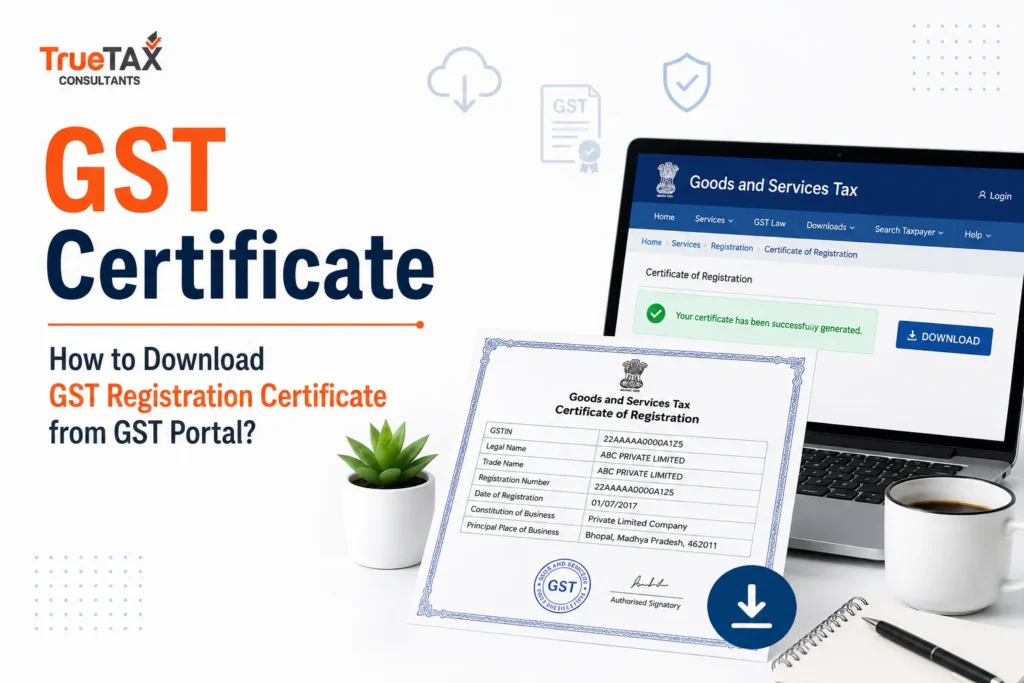
Have you recently completed your GST registration but are struggling to find or download your GST certificate? You’re not alone. Many business owners, startups, freelancers, traders, and professionals face this issue after their GST application gets approved.
Unlike some government registrations, the GST department does not send a physical certificate by post. Instead, the GST Registration Certificate is issued digitally and must be downloaded directly from the GST Portal. Whether you’re opening a bank account, registering on an e-commerce marketplace, onboarding vendors, applying for loans, or participating in government tenders, you’ll often be asked to provide your GST certificate.
The good news is that downloading your GST Registration Certificate is simple and takes only a few minutes if you know where to look.
In this comprehensive guide, you’ll learn how to download a GST registration certificate from the GST Portal, understand its validity, know what information it contains, and discover common issues and solutions related to GST certificate downloads.
Key Takeaways
- The GST Registration Certificate is issued in Form GST REG-06.
- No physical GST certificate is issued by the government.
- The certificate can only be downloaded online through the GST Portal.
- Regular taxpayers receive a certificate with no expiry date unless cancelled or surrendered.
- Casual and Non-Resident Taxable Persons receive certificates valid for up to 90 days.
- Displaying the certificate at every registered business location is mandatory.
- Failure to display the certificate can attract penalties under GST regulations.
What Is a GST Registration Certificate?
A GST Registration Certificate is an official government document issued to businesses that successfully register under the Goods and Services Tax (GST) regime.
The certificate is issued in Form GST REG-06 and serves as proof that the business is legally registered under GST laws in India.
Once GST registration is approved, taxpayers receive a unique Goods and Services Tax Identification Number (GSTIN). This GSTIN, along with important business details, is reflected on the GST certificate.
The certificate is generated electronically and verified digitally by the concerned GST officer. Since the GST system is fully online, taxpayers must download the certificate themselves from the GST Portal whenever required.
Why Is the GST Registration Certificate Important?
Many business owners assume the GST certificate is merely a registration document. In reality, it plays a critical role in compliance and business operations.
Legal Proof of GST Registration
The certificate confirms that your business is legally registered under GST and authorized to collect tax from customers.
Required for Banking and Financial Transactions
Banks often request certificates when opening current accounts or processing business loans.
Vendor and Marketplace Registration
Many vendors, suppliers, and online marketplaces require a certificate before onboarding businesses.
Government Tenders and Contracts
Government departments frequently ask for certificates during tender applications and procurement processes.
Business Credibility
A certificate enhances trust among customers, vendors, financial institutions, and regulatory authorities.
Input Tax Credit Benefits
The certificate confirms eligibility to claim Input Tax Credit (ITC), subject to GST compliance requirements.
Who Receives a GST Registration Certificate?
Several categories of taxpayers are eligible to receive GST registration certificates.
These include:
- Regular taxpayers
- Proprietorship firms
- Partnership firms
- Limited Liability Partnerships (LLPs)
- Private Limited Companies
- Public Limited Companies
- Trusts
- Societies
- Exporters
- Importers
- Composition taxpayers
- Casual taxable persons
- Non-Resident Taxable Persons (NRTPs)
- TDS deductors
- TCS collectors
- UIN holders
- Businesses migrated from the pre-GST tax regime
Regardless of business type, the certificate remains one of the most important GST compliance documents.
When Do You Need a GST Registration Certificate?
Many taxpayers only realize the importance of the GST certificate when someone asks for it unexpectedly.
Here are common situations where you’ll need a GST registration certificate:
- Opening a Business Bank Account: Most banks require proof of GST registration before opening a current account for a business. A GST certificate helps establish the legitimacy of the business and simplifies account opening procedures.
- Vendor Onboarding: Large corporations, government departments, and enterprise clients often request a GST Registration Certificate before adding a supplier or service provider to their vendor network.
- E-Commerce Registration: Online marketplaces such as Amazon, Flipkart, Meesho, and other e-commerce platforms may require GST registration documents during the seller onboarding process.
- Business Loans and Funding: Banks, NBFCs, and financial institutions may use a GST certificate to verify business authenticity and assess eligibility for loans, credit facilities, and funding.
- Government Tenders: Participation in government tenders and procurement contracts typically requires businesses to submit valid GST registration proof as part of the eligibility criteria.
- Compliance Audits: Tax authorities, auditors, and compliance officers may request a GST Registration Certificate during audits, inspections, or regulatory reviews.
- Business Credibility and Trust: A GST certificate enhances a business’s credibility by demonstrating legal compliance and helping build trust among customers, suppliers, and business partners.
Having quick access to your GST Registration Certificate can save valuable time and prevent delays when dealing with banking, vendor registration, audits, funding applications, and government contracts.
How to Download GST Registration Certificate from GST Portal Easily
If your GST registration has already been approved, you can download the certificate directly from the GST Portal.
Follow these simple steps:
Step 1: Login to the GST Portal
Visit the GST Portal and log in using your username and password.
Make sure you use the credentials linked to your GST registration.
Step 2: Navigate to User Services
After logging in, go to:
Services → User Services → View/Download Certificates
This section contains your GST Registration Certificate and any updated versions issued after amendments.
Step 3: Access Form GST REG-06
The GST Registration Certificate will appear in Form GST REG-06 format.
Review the displayed information before downloading.
Step 4: Click the Download Button
Click the download icon available on the page.
The certificate will be downloaded as a PDF document.
Step 5: Save and Print the Certificate
Save the PDF securely on your computer or cloud storage.
Take a printed copy and display it prominently at your business premises.
Step 6: Download Updated Certificates After Amendments
If you’ve amended business details such as:
- Trade name
- Business address
- Partners or directors
- Business constitution
The updated certificate will be available in the same section.
Always download and retain the latest version.
Can You Download a GST Certificate Without Login?
One of the most frequently asked questions is whether taxpayers can download their GST certificates without logging into the GST Portal.
The answer is No.
GST Registration Certificates can only be accessed through the taxpayer’s GST account. To download the certificate, you must have:
- GST Username
- GST Password
- Active GST Registration
However, if your goal is only to verify a GST number, you can use the public taxpayer search facility available on the GST Portal without logging in.
Important Compliance Requirement After Downloading the GST Certificate
Downloading the certificate is only part of the compliance requirement.
Under GST regulations, every registered taxpayer must display the GST Registration Certificate prominently at:
- Principal Place of Business
- Additional Places of Business
This helps customers, tax authorities, and other stakeholders verify GST registration easily.
Failure to comply can lead to penalties, which we’ll discuss later in this guide.
Validity of GST Registration Certificate
One of the most common questions taxpayers ask is whether the Certificate expires and requires renewal.
The answer depends on the type of taxpayer registered under GST.
Validity of GST Certificate by Taxpayer Type
| Taxpayer Type | Validity Period |
| Regular Taxpayer | Permanent (until cancelled, surrendered, or revoked) |
| Composition Taxpayer | Permanent (until cancelled, surrendered, or revoked) |
| Casual Taxable Person | Up to 90 days (extendable) |
| Non-Resident Taxable Person (NRTP) | Up to 90 days (extendable) |
For most businesses, the GST Registration Certificate remains valid indefinitely unless the registration is cancelled voluntarily or by the GST authorities.
When Does GST Certificate Validity Begin?
The certificate becomes effective from the date on which the taxpayer became liable for GST registration, provided the application was submitted within the prescribed timeline.
If the registration application is filed after the prescribed period, the certificate generally becomes effective from the date registration is granted by the GST department.
What Information Is Mentioned on the GST Registration Certificate?
The Certificate contains important details about the taxpayer and business.
The certificate consists of:
- Main GST Registration Certificate
- Annexure A
- Annexure B
Each section contains specific information required for GST compliance and business verification.
Main GST Registration Certificate Details
The main certificate includes the core registration information of the taxpayer.
GSTIN (Goods and Services Tax Identification Number)
A unique 15-digit GST Identification Number assigned to the taxpayer.
This number is required for:
- GST return filing
- Invoice generation
- Tax payments
- Vendor verification
- Compliance reporting
Legal Name of the Business
The legal name reflects the official name registered under PAN and GST records.
This name must match government records and registration documents.
Trade Name
The trade name refers to the name under which the business operates publicly.
In some cases, the trade name and legal name may be identical.
Business Constitution Type
The certificate displays the constitution of the business entity, such as:
- Proprietorship
- Partnership Firm
- LLP
- Private Limited Company
- Public Limited Company
- Trust
- Society
- HUF
This helps stakeholders identify the legal structure of the organization.
Principal Place of Business
The certificate contains the complete address of the primary business location registered under GST.
This address serves as the main place for GST correspondence and compliance purposes.
Date of Liability
This section specifies the date from which GST liability became applicable to the taxpayer.
Registration Type
The GST certificate identifies the taxpayer category, such as:
- Regular Taxpayer
- Composition Dealer
- Casual Taxable Person
- Non-Resident Taxable Person
Validity Period
Where applicable, the certificate also specifies the validity period of registration.
This is especially relevant for temporary registrations.
Details of Approving Authority
The certificate contains details of the GST officer responsible for approving the registration, including:
- Name
- Designation
- Jurisdiction
- Digital Signature
Date of Issue
This indicates the date on which the GST Registration Certificate was officially issued.
What Is Annexure A in GST Registration Certificate?
Annexure A contains information about additional places of business declared by the taxpayer during registration.
This annexure becomes important for businesses operating from multiple locations.
Details Available in Annexure A
Annexure A generally contains:
- GSTIN
- Legal Name
- Trade Name
- Additional Places of Business
If no additional locations are declared, Annexure A may contain minimal information.
What Is Annexure B in GST Registration Certificate?
Annexure B provides information about key persons responsible for the business.
This section helps authorities identify individuals associated with the registered entity.
Details Available in Annexure B
The following information is generally included:
- GSTIN
- Legal Name
- Trade Name
- Name of Proprietor
- Partners
- Directors
- Trustees
- Karta
- Managing Director
- CEO
- Designated Partners
- State of Residence
- Designation
- Photograph of Key Persons
The exact details vary depending on the type of business entity.
Understanding the GST Registration Certificate Structure
Think of the Certificate as a business identity document.
Main Certificate
Contains primary registration details.
Annexure A
Contains information about additional business locations.
Annexure B
Contains information about persons responsible for managing the business.
Together, these sections provide a complete overview of the GST-registered entity.
GST Registration Certificate for Different Types of Taxpayers
Although the overall certificate format remains similar, certain details vary depending on the taxpayer category.
GST Certificate for Regular Taxpayers
Regular taxpayers receive the standard Certificate.
Features
- No expiry date
- Eligible for Input Tax Credit
- Can collect GST from customers
- Can file regular GST returns
Most businesses registered under GST fall into this category.
GST Certificate for Composition Taxpayers
Composition taxpayers receive a GST certificate similar to regular taxpayers, but with specific restrictions.
Key Characteristics
- Registered under Composition Scheme
- Cannot collect GST from customers separately
- Cannot claim Input Tax Credit
- Must comply with composition scheme rules
The certificate clearly identifies the taxpayer as a composition dealer.
GST Certificate for Casual Taxable Persons
Casual taxable persons generally participate in temporary or seasonal business activities.
Examples include:
- Trade fairs
- Exhibitions
- Temporary events
- Seasonal businesses
Key Characteristics
- Valid for up to 90 days
- Extension available
- Advance GST payment generally required
The certificate reflects the temporary nature of the registration.
GST Certificate for Non-Resident Taxable Persons (NRTPs)
Foreign businesses conducting taxable transactions in India may register as Non-Resident Taxable Persons.
Key Characteristics
- Valid for up to 90 days
- Extension available
- Applicable to foreign entities
- GST certificate must be displayed at the business location in India
The certificate confirms temporary GST registration for business activities within India.
GST Certificate for Exporters
Exporters receive the same GST Registration Certificate structure as regular taxpayers.
However, the registration enables access to export-related GST benefits.
Benefits for Exporters
- Eligibility for GST refunds
- Claim of accumulated Input Tax Credit
- Export under LUT provisions
- IGST exemption benefits where applicable
Maintaining an active GST registration is essential for exporters seeking these advantages.
Why Businesses Should Regularly Review Their GST Certificate
Many businesses download their GST certificate once and never review it again.
However, periodic review is important to ensure:
- Business details remain accurate
- Address information is updated
- Stakeholder information is current
- Additional business locations are properly reflected
- Compliance records remain accurate
An outdated GST certificate can create issues during audits, vendor onboarding, banking procedures, and government tenders.
Continue with Batch 3, covering:
- How to Amend GST Registration Certificate
- Core vs Non-Core Amendments
- Step-by-Step Amendment Process
- Common GST Certificate Download Problems and Solutions
- Penalty for Not Displaying GST Certificate
- Benefits of Keeping GST Certificate Updated
- Conclusion
- TrueTax Consultant CTA
- FAQs with exact 45-word answers
How to Amend a GST Registration Certificate
Business details can change over time. You may move to a new office, add a partner, update your trade name, or change other registration information. In such cases, the Certificate must be updated to reflect the latest details.
The GST Portal allows taxpayers to amend their registration information through a simple online process.
However, not all amendments are treated the same. Some changes require approval from a GST officer, while others are automatically approved.
Core Field Changes in GST Registration
Core field amendments are significant changes that directly affect the taxpayer’s registration details.
These changes require verification and approval by the GST department.
Examples of Core Field Changes
- Change in Legal Name of Business (where PAN remains unchanged)
- Change in Trade Name
- Change in Principal Place of Business (within the same state)
- Addition of New Partners
- Removal of Existing Partners
- Addition of Directors
- Change in Managing Director
- Change in Board of Trustees
- Addition or Removal of Karta
- Addition or Removal of Promoters
Since these changes impact the primary registration details, GST officer approval is mandatory before the amended certificate is issued.
Non-Core Field Changes in GST Registration
Non-core field changes are relatively minor updates that generally do not require officer intervention.
These amendments are usually approved automatically after successful submission.
Examples of Non-Core Field Changes
- Addition of Bank Account Details
- Modification of Existing Bank Accounts
- Deletion of Bank Accounts
- Changes in Business Activities
- Update of Goods and Services Details
- Modification of Authorized Signatory Information
- Minor Updates to Business Address Information
- State-Specific Information Updates
These amendments help keep GST records current without lengthy approval procedures.
Step-by-Step Process to Amend GST Registration Certificate
If any information on your GST certificate is incorrect or outdated, follow these steps to update it.
Step 1: Login to GST Portal
Access the GST Portal using your GST username and password.
Step 2: Navigate to Registration Services
Go to:
Services → Registration → Amendment of Registration
Select either:
- Core Fields Amendment
- Non-Core Fields Amendment
depending on the information being updated.
Step 3: Update Required Information
Make the necessary changes carefully.
Ensure all updated information matches supporting documents.
Step 4: Upload Supporting Documents
Upload the required documents based on the amendment type.
Examples include:
- Address proof
- Utility bills
- Partnership deed
- Board resolution
- Business registration documents
Step 5: Verify and Submit Application
Submit the amendment request using:
- DSC (Digital Signature Certificate)
- E-Sign
- Electronic Verification Code (EVC)
Step 6: Download the updated GST Certificate
Once approved, the revised GST Registration Certificate will be available in the View/Download Certificates section of the GST Portal.
Always download and store the updated version for future use.
Common GST Certificate Download Problems and Solutions
While downloading the GST Registration Certificate is generally straightforward, taxpayers occasionally encounter issues.
Below are some common challenges and their solutions.
| Issue | Solution |
| Forgotten Username | Use the “Forgot Username” option on the GST Portal |
| Forgotten Password | Reset password using OTP verification |
| Incorrect GSTIN | Verify the GSTIN before login and certificate access |
| Technical Portal Errors | Wait and retry after some time |
| Slow Portal Response | Try accessing during non-peak hours |
| Suspended GST Registration | Resolve compliance issues before downloading |
| Browser Compatibility Issues | Use an updated browser version |
| Certificate Not Showing | Check registration approval status first |
What If Your GST Registration Is Suspended?
If your GST registration has been suspended, access to certain GST services may be restricted.
Common reasons include:
- Non-filing of GST returns
- Pending compliance notices
- Mismatch in GST returns
- Regulatory scrutiny
Before attempting to download the certificate, ensure all pending compliance obligations have been completed.
Penalty for Not Displaying GST Registration Certificate
Many taxpayers are unaware that displaying the Certificate at business premises is mandatory.
According to GST regulations, every registered taxpayer must prominently display:
- GST Registration Certificate
- GSTIN at the place of business
This requirement applies to:
- Principal Place of Business
- Additional Places of Business
Why Is Displaying the GST Certificate Important?
Displaying the certificate helps:
- Customers verify registration
- Tax officers conduct inspections
- Vendors confirm business legitimacy
- Improve transparency
Penalty for Non-Compliance
Failure to display the GST Registration Certificate can attract penalties of up to ₹25,000 under GST provisions.
Considering the simplicity of compliance, businesses should ensure the certificate is displayed at all registered locations.
Benefits of Keeping Your GST Certificate Updated
Many businesses update GST details only when absolutely necessary. However, maintaining an updated GST Registration Certificate offers several benefits.
Improved Compliance
Accurate GST records reduce the risk of notices and compliance issues.
Smooth Vendor Onboarding
Most organizations verify GST certificates before engaging with suppliers.
Easier Loan Approvals
Banks and financial institutions often review GST documents during loan processing.
Faster Tender Participation
Updated certificates simplify documentation requirements during tender submissions.
Enhanced Business Credibility
Accurate and current registration records create trust among customers and stakeholders.
Best Practices for Managing GST Registration Certificates
To avoid future complications, businesses should adopt these simple practices:
Keep Digital Copies Secure
Store GST certificates in multiple secure locations, including cloud storage.
Review Certificate Periodically
Verify that all information remains accurate.
Download Updated Certificates After Amendments
Always retain the latest version after any registration changes.
Display Printed Copies Properly
Ensure certificates are visible at all registered locations.
Monitor GST Compliance Regularly
Timely return filing and compliance help maintain active registration status.
Conclusion
The GST Registration Certificate is one of the most important compliance documents for any GST-registered business in India. Issued in Form GST REG-06, it serves as official proof of GST registration and is required for banking, vendor onboarding, tenders, audits, tax compliance, and various business transactions.
Since the GST department does not issue physical certificates, taxpayers must download them directly from the GST Portal. Whether you’re a startup, freelancer, exporter, partnership firm, or private limited company, knowing how to download, update, and maintain your GST certificate is essential for smooth business operations.
By following the steps outlined in this guide, businesses can easily access their GST certificates, understand the information contained within them, make necessary amendments, and remain fully compliant with GST regulations.
Need Help with GST Registration or GST Certificate Updates?
Managing GST registration, amendments, compliance requirements, and GST documentation can sometimes be confusing and time-consuming.
TrueTax Consultant helps businesses across India with:
- GST Registration Services
- GST Return Filing
- GST Notice Handling
- GST Compliance Management
- GST Cancellation & Revocation Support
- Input Tax Credit (ITC) Assistance
Whether you’re applying for GST registration for the first time or need help updating your GST certificate, our experts can guide you through every step.
Contact Truetax Consultants today and simplify your GST compliance journey with professional support.
FAQs
Is a GST Certificate the Same as a GST Registration Certificate?
Yes. A GST Certificate and GST Registration Certificate refer to the same document issued in Form GST REG-06. It serves as official proof that a business is registered under GST and authorized to conduct taxable activities, collect GST, and comply with applicable GST regulations legally.
Can I Download My GST Certificate Without Logging Into the GST Portal?
No. Taxpayers must log into their GST account using valid credentials to access and download the Certificate. While GST registration details can be publicly verified using GSTIN, downloading Form GST REG-06 requires authorized login access through the GST Portal account only.
How Long Is a GST Registration Certificate Valid?
For regular taxpayers, the Certificate does not have an expiry date and remains valid until cancelled, surrendered, or revoked. However, casual taxable persons and non-resident taxable persons generally receive registrations valid for up to ninety days, subject to extension provisions under GST.
What Should I Do If There Is an Error in My GST Certificate?
If any information on your GST Certificate is incorrect, submit an amendment application through the GST Portal. Depending on whether the change relates to core or non-core fields, approval may be automatic or require verification by a GST officer before the updated certificate is issued.
Is Displaying the GST Registration Certificate Mandatory at Business Premises?
Yes. GST regulations require every registered taxpayer to prominently display the Certificate at the principal place of business and all additional locations. Failure to comply may result in penalties. Displaying the certificate helps establish transparency and confirms the business’s GST registration status.
Do proprietorship firms receive a different GST certificate?
No. Proprietorship firms receive the same Form GST REG-06 as other taxpayers. However, the certificate reflects the proprietor’s details, legal name, trade name, and registered business address specific to the proprietorship entity.
Why is my GST certificate not visible on the GST Portal?
This may happen if your GST registration application is still under processing, awaiting approval, or facing compliance issues. Verify your registration status and ensure there are no pending notices or technical issues affecting portal access.